Flood Mitigation
Background
Since Tropical Storm Irene, the Town has sought strategic opportunities to mitigate the impact of future floods on our residents and businesses. The floods of July 2023, December 2023, and July 2024 spurred the Town into action to make greater progress in mitigation, to improve our planning to ensure we are able to notify our residents if a flood is impending, and to marshall the efforts of Town staff and community volunteers if a flood recovery effort becomes necessary.
Flood Hazard Information
NWS river gauge on Winooski River NWS weather information resources
Randall Meadow Project
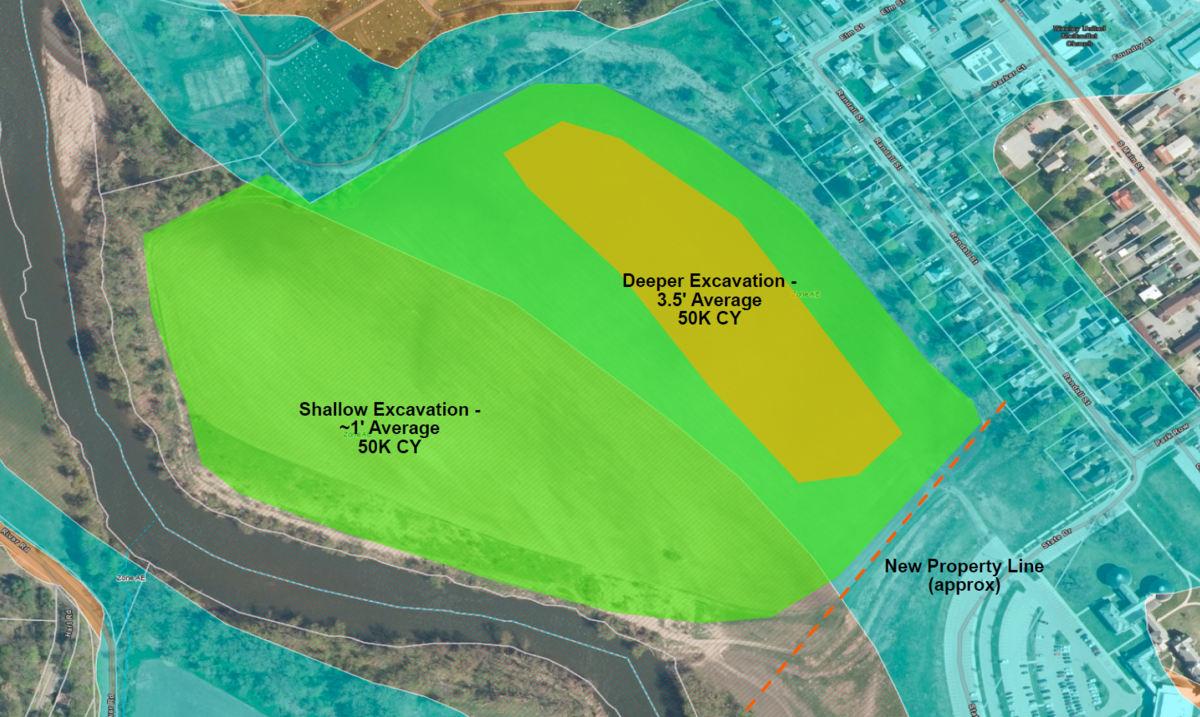
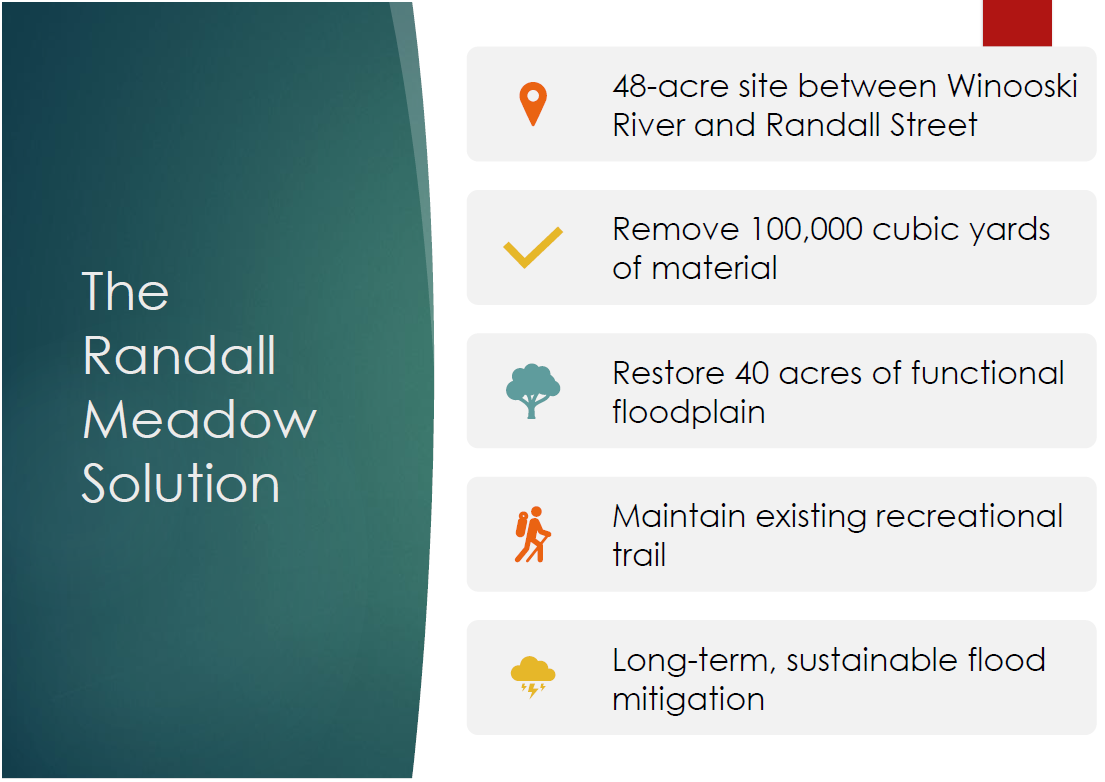
During the 2025 legislative session the State of Vermont heard testimony from the Town about the Randall Meadow, which is the agricultural field between Randall Street, the State Office Complex, and the Winooski River. The Town has contracted with SLR Consulting, a firm with a specific practice in hydrology modeling, to analyze the possibility of lowering the land to reduce the impact of a future flood. The resulting analysis suggests there would be between 4 inches and up to 1 foot of flood relief (during a 50-year flood) for not just the Randall and Elm Street neighborhoods, but the entire area of South Main Street that sits in the floodplain. Read a summary of this preliminary work…..
The land, a parcel of about 45 acres, has been surveyed and subdivided, and the plan is for the State to transfer ownership to the Town at some point in the near future, at no cost to taxpayers, as part of the project implementation.
Funding
In the fall of 2025, the Town submitted a grant application to the State’s Community Development Block Grant Disaster Relief (CDBG-DR) program. The estimated budget for the entire project is $4.3 million, and we were awarded a total of $2.0 million. As a condition of the grant award, the Town must prove it can complete the full project as envisioned, or revise the scope of the project to limit the expenditures to the amount of the grant award. Read the award letter….
A version of this project was previously submitted for a hazard mitigation grant, but the application was not selected for funding.
The only way to meet the conditions of the grant and complete the project as proposed is to hold a public bond vote, which ensures the Town has the legal authority to borrow the funds needed. Without that legal authority, the State will not provide us with a grant agreement, which means any funds we spend on the project will not be paid by the grant. In short, the project does not move forward without this vote.
Our attorney advised it is both prudent and traditional to request authority to borrow the full project amount of $4.3 million, in the odd event the grant funds are later withdrawn. This would be a very unlikely possibility, and the Select Board would most certainly pause the project if that were to happen. Based on the current grant application, even if no additional funding is received, the Town would only need to bond for $2.3 million to meet the budget. We are also well-positioned to receive another significant grant. However, that grant application will be far stronger when the project is fully designed and engineered. Other grant opportunities may also emerge to defray the cost of the project to the town. Grant money would be the first payer on costs incurred by the project.
This message from the Selectboard about the bond vote contains greater detail on the information provided here and is intended to provide voters with answers to the most frequently asked questions and concerns.
Voters approved the bond on Town Meeting Day, March 3, 2026.
As noted above, the Town would borrow the net cost of $2.3 million. Using our current tax rate for purposes of comparison, this would increase your taxes by an estimated 3.7% if the Town issued a 20-year bond. Fortunately, because we don’t anticipate issuing the bond for 18-24 months, the debt payments would not impact the budget for several years—likely 2028 at the earliest.
Further, the debt payments can be phased in over several years, and the town may be able to service the debt, or a portion of the debt, using the local option tax, which would avoid any increase in your property taxes.
The following documents show the debt service scenarios for amortization over different time periods:
10-yr LP 15-yr LP 20-yr LP 25-yr LP
Project stages and progress
Environmental Assessment - Wetlands Delineation
The Town has engaged VHB to conduct the next stage of environmental assessment of the Randall Meadow site, beginning with wetlands delineation, which must be completed by October 15, 2026. A formal project kickoff meeting with VHB will take place in October. VHB is responsible for producing a complete HUD-compliant environmental assessment that supports project approval and issuance of Authority to Use Grant Funds. Read the RFP here….
Floodplain restoration conceptual design
Alongside the environmental assessment work, Waterbury Pathways has been developing preliminary concept designs for floodplain restoration that can incorporate additional community amenities for conservation and recreation, including enhancing the existing Cross Vermont Trail. Once the environmental assessment is complete the conceptual design phase will formally begin where community members will be able to give feedback on what they would like to see on this property.
In anticipation of the conceptual design phase, the project team wants to hear from the community. What would you like to see at Randall Meadow? A survey to collect community responses will be open until October 22, 2026, and the responses will be used to inform a community design workshop.